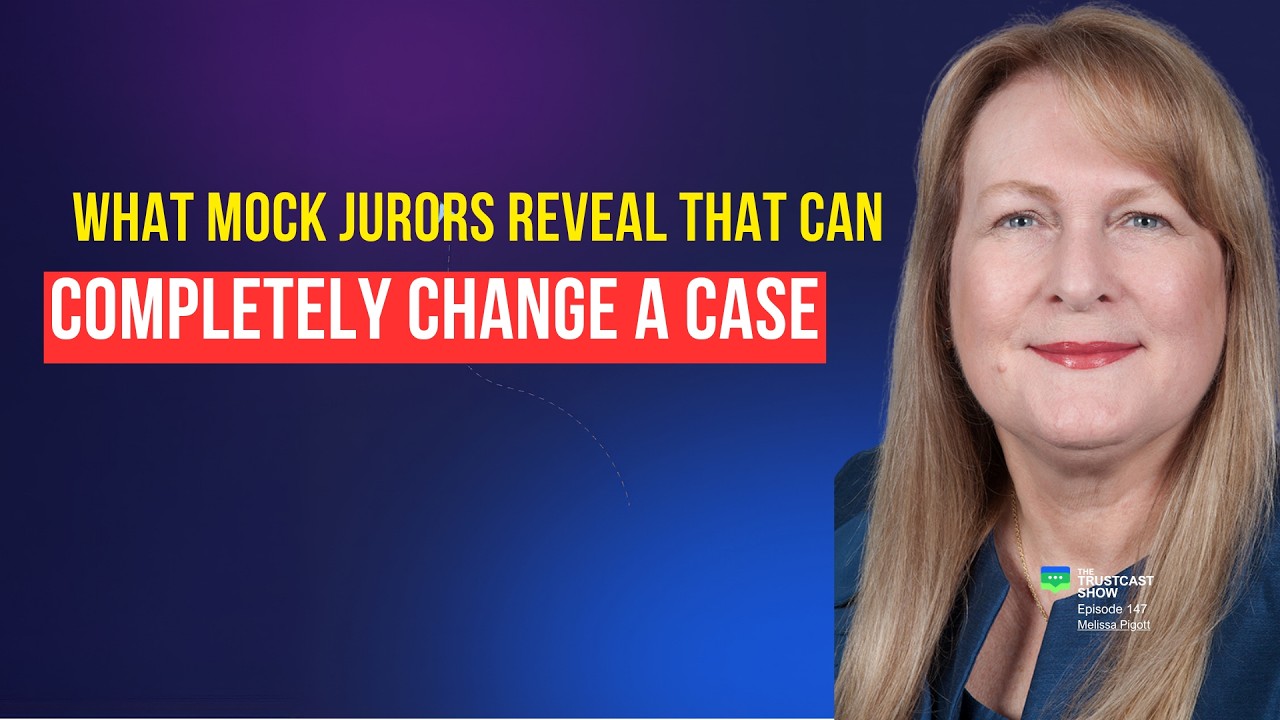
What happens when a PhD student studying eyewitness identification under groundbreaking research that would eventually inspire the Innocence Project decides that the most important unanswered question in the legal system is not whether the truth happened but whether a jury will actually find it — and then spends the next 45 years building a science around that question, helping attorneys win and settle thousands of cases worth billions of dollars, learning how to fly a plane in a simulator to understand an airline crash well enough to explain it to a mock jury, and watching insurance adjusters arrive at research day saying this case isn’t worth anything and then change their minds before lunch?
In this episode of the Trustcast Show, Zane Myers speaks with Dr. Melissa Pigott, co-founder of Magnus Research Consultants, about what a mock trial actually looks like from the inside — twelve to fifteen hours, multiple groups per day, real cases, real verdict forms, real jury instructions, four-person forepersons who sometimes get selected because they were sitting at the head of the table — and why the deliberations are where the real revelations happen, including fights that have to be broken up, coalitions that form along unexpected lines, and jurors who seize on a tiny detail the attorneys brushed aside and carry the whole day with it. Melissa explains why attorneys’ biggest blind spot is their own advocacy — they spend years on a case and cannot see what someone hearing it for the first time actually takes away — and why the most common shock in the room is watching a mock jury ignore a carefully prepared exhibit notebook and decide based on common sense instead.
They also discuss why most clients now hire Magnus before mediation rather than trial because almost no cases actually go to trial anymore, how the plaintiff’s attorneys in the Exxon dealers case lost a real trial, brought Magnus in to rebuild everything, and won $1.2 billion at the retrial, why pre-existing attitudes and worldviews matter more than the evidence when it comes to what a juror ultimately decides, why federal judges in some jurisdictions will hold you in contempt for checking a juror’s social media during trial, how to identify in voir dire who is going to be a plaintiff juror and who is going to be a defense juror based on statistical profiles built from prior research, and why the foreperson is almost never who the attorneys predicted.
Dr. Melissa Pigott is the co-founder of Magnus Research Consultants, a trial consulting firm she has led since 1993, based in Florida and working cases nationwide.
Connect with Dr. Melissa Pigott:
Magnus Research Consultants
Contact: David Fauss — partner and first point of contact
magnusresearch.com